How to Implement Microservice Coded In Hackathon Event
Microservices in GraphQL
Hey Family,
As you already know with the title we are going to discuss, Trending topics of 2020 today. I promise today's Blog would change your thinking about how Projects are currently working and how they will work in the coming time.
Hold it and stay tuned for the below-mentioned topics:
- What is Microservices Architecture?

GraphQL with Microservice using Docker
- Construct an application as a set of services that are, Highly maintainable and testable.
- Loosely coupled.
- Deployed, Maintained and Developed independently
- From the starting separated by service boundaries which make it more convenient to scale up the development effort if needed
- Making it more convenient to choose the technology stack (programming databases, languages, etc.) which is best suited for the required service
- Monolithic vs Microservices
- Monolithic

Monolithic Architecture
- Single Code Base
- Often time-consuming and confusing
- Difficult deployment with maintenance window and schedule downtime
- Generally entirely developed in one programing language
- Required you to scale the whole application even through impasses are localized
- Microservice

Microservice Architecture
- Multicode codebase, every microservice has its own codebase
- Much easy to maintain and readability of code
- Simple deployment, as each microservice can be deployed individually, with zero downtime
- Each microservice can be implemented in a different programming language.
- Enables you to scale impasses services without scaling the entire application
- How does microservice solve current issues in project development?
- Current situation
- Monolithic Architecture
- High time consuming
- Too large and complex code structure
- Hard to understand & make changes
- Which eventually cause slow, repetitive development
- At last effects at the Project Closure
- Problem Solving Statement
- Microservices Architecture
- Simple to develop
- Service/Technology/Platform/OS Independent
- One time API Development with Single End Point
- Stable, faster, flexible and secure application development
- Server Virtualization for better resource management
- On-Demand Architecture
- What is Docker?
- Docker is a tool planned to make it simpler to create, deploy, and run applications by using containers.
- OS-level virtualization to deliver software in packages called containers
- Enables more effective use of system resources
- Enables Faster software Delivery & Integration cycles
- Best suitable tech to implement a microservices architecture
- Instances of containerized apps use far less memory than virtual machines, they start up and stop more quickly
- Ultimate benefits of infrastructure cost saving
- Read more: ALL ABOUT DOCKER CONTAINER
- Implement microservices with docker
- Now as you know what is microservices and what is docker.
- Let's get started by creating multiple microservices using a docker container.
- Just imagine that every container is your individual microservices which are into multiple languages or technologies.
- Each container works are an independent service that can be run on multiple ports under the same Operating System.
- This is known as OS-level virtualization.
- Let's see how we can achieve the same:
- Step 1: Install Docker
- Step 2: Install Docker Compose
- Step 3: Prepare the Environment
- Step 1: NGINX / Apache
- Step 2: Database
- Step 3: Web
- Step 4: Create a docker-compose.yml
- Step 5: Test the Microservice
- You can run multiple containers for every individual microservice under a single OS.
- What is GraphQL?
- GraphQL is a syntax that characterizes how to ask for data and is commonly used to load data from the server to a client.
- GraphQL has three main features:
- The client specifies exactly what data it needs.
- It makes it simple to collect data from multiple sources.
- It uses a type system to explain data.
- Pros and Cons of GraphQL vs REST

GraphQL vs REST
Thus here is the award for our achievement on this idea:
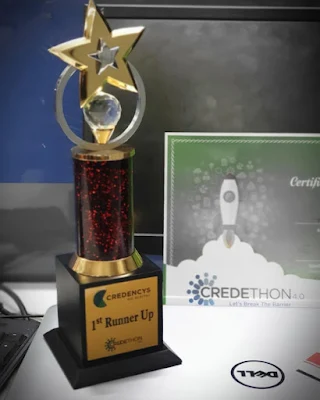
Credethon 4.0
Youtube: https://www.youtube.com/c/TapanPatni
Linkedin: https://www.linkedin.com/in/tapan-patni
BlogSpot: https://tapanpatni58.blogspot.com
 |
| GraphQL with Microservice using Docker |
- Construct an application as a set of services that are, Highly maintainable and testable.
- Loosely coupled.
- Deployed, Maintained and Developed independently
- From the starting separated by service boundaries which make it more convenient to scale up the development effort if needed
- Making it more convenient to choose the technology stack (programming databases, languages, etc.) which is best suited for the required service
- Monolithic
Monolithic Architecture
- Single Code Base
- Often time-consuming and confusing
- Difficult deployment with maintenance window and schedule downtime
- Generally entirely developed in one programing language
- Required you to scale the whole application even through impasses are localized
- Microservice
Microservice Architecture
- Multicode codebase, every microservice has its own codebase
- Much easy to maintain and readability of code
- Simple deployment, as each microservice can be deployed individually, with zero downtime
- Each microservice can be implemented in a different programming language.
- Enables you to scale impasses services without scaling the entire application
 |
| Monolithic Architecture |
- Single Code Base
- Often time-consuming and confusing
- Difficult deployment with maintenance window and schedule downtime
- Generally entirely developed in one programing language
- Required you to scale the whole application even through impasses are localized
 |
| Microservice Architecture |
- Multicode codebase, every microservice has its own codebase
- Much easy to maintain and readability of code
- Simple deployment, as each microservice can be deployed individually, with zero downtime
- Each microservice can be implemented in a different programming language.
- Enables you to scale impasses services without scaling the entire application
- Current situation
- Monolithic Architecture
- High time consuming
- Too large and complex code structure
- Hard to understand & make changes
- Which eventually cause slow, repetitive development
- At last effects at the Project Closure
- Problem Solving Statement
- Microservices Architecture
- Simple to develop
- Service/Technology/Platform/OS Independent
- One time API Development with Single End Point
- Stable, faster, flexible and secure application development
- Server Virtualization for better resource management
- On-Demand Architecture
- Monolithic Architecture
- High time consuming
- Too large and complex code structure
- Hard to understand & make changes
- Which eventually cause slow, repetitive development
- At last effects at the Project Closure
- Microservices Architecture
- Simple to develop
- Service/Technology/Platform/OS Independent
- One time API Development with Single End Point
- Stable, faster, flexible and secure application development
- Server Virtualization for better resource management
- On-Demand Architecture
- Docker is a tool planned to make it simpler to create, deploy, and run applications by using containers.
- OS-level virtualization to deliver software in packages called containers
- Enables more effective use of system resources
- Enables Faster software Delivery & Integration cycles
- Best suitable tech to implement a microservices architecture
- Instances of containerized apps use far less memory than virtual machines, they start up and stop more quickly
- Ultimate benefits of infrastructure cost saving
- Read more: ALL ABOUT DOCKER CONTAINER
- Now as you know what is microservices and what is docker.
- Let's get started by creating multiple microservices using a docker container.
- Just imagine that every container is your individual microservices which are into multiple languages or technologies.
- Each container works are an independent service that can be run on multiple ports under the same Operating System.
- This is known as OS-level virtualization.
- Let's see how we can achieve the same:
- Step 1: Install Docker
- Step 2: Install Docker Compose
- Step 3: Prepare the Environment
- Step 1: NGINX / Apache
- Step 2: Database
- Step 3: Web
- Step 4: Create a docker-compose.yml
- Step 5: Test the Microservice
- You can run multiple containers for every individual microservice under a single OS.
- Step 1: Install Docker
- Step 2: Install Docker Compose
- Step 3: Prepare the Environment
- Step 1: NGINX / Apache
- Step 2: Database
- Step 3: Web
- Step 4: Create a docker-compose.yml
- Step 5: Test the Microservice
- GraphQL is a syntax that characterizes how to ask for data and is commonly used to load data from the server to a client.
- GraphQL has three main features:
- The client specifies exactly what data it needs.
- It makes it simple to collect data from multiple sources.
- It uses a type system to explain data.
- The client specifies exactly what data it needs.
- It makes it simple to collect data from multiple sources.
- It uses a type system to explain data.
 |
| GraphQL vs REST |
 |
| Credethon 4.0 |
Linkedin: https://www.linkedin.com/in/tapan-patni
BlogSpot: https://tapanpatni58.blogspot.com


Awesome......
ReplyDeleteThank you so much please check my other blogs on Trending Topics
DeleteHii tapan dhanga here ,
ReplyDeleteI dont know you but i reall liked your work wishing you all the best for your future.hope to meet you soon..
Hi Tapan,
ReplyDeleteYou Rock, Saw your all posts till date. The concept of docker has been explained very well to get a clear picture on docker.
I thank you for the provided subject till date and will be waiting for further updates on other DevOps tools and topics in the blog.
This is an amazing blog, thank you so much for sharing such valuable information with us.
ReplyDeleteMicroservices Online Training
Microservices Training in Hyderabad
Harrahs Atlantic City Hotel in Atlantic City, NJ
ReplyDeleteBook the 카지노 Harrahs 토토 캔 Atlantic City 바카라 전략 Hotel. Entertainment 카지노 사이트 · Live Casino · Dining · Reservation 바카라 사이트 · Hotel
Microservices in GraphQL is such an exciting topic! If you're exploring complex subjects like this and struggling to keep up with your class, you can pay someone to take your online English Communication class and focus on diving deeper into tech innovations.
ReplyDelete